
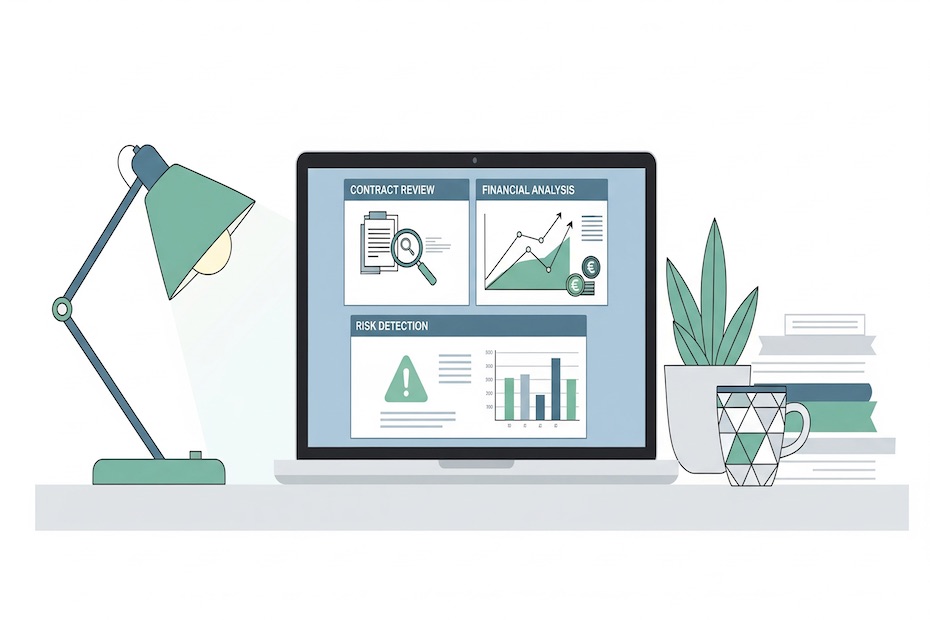
AI speeds up due diligence and deal analysis by automating document review, extracting insights from large data sets, and reducing review time by as much as 70%.
This article shows how AI enhances legal, financial, and operational due diligence. You’ll see what AI-powered due diligence is, how it reduces error rates, which tools lead the market, and where human oversight still matters.
What is AI-powered due diligence in M&A?
AI-powered due diligence refers to the use of machine learning, natural language processing (NLP), and predictive analytics to automate core diligence tasks.
Instead of manually reviewing contracts and financial records, AI scans thousands of pages within minutes. It highlights red flags, extracts key clauses, and produces structured reports. Platforms like Keye and DealRoom use these capabilities to help deal teams identify risks early.
The benefit is speed and precision. You no longer need to spend weeks combing through documents—AI reduces administrative work so you can focus on deal strategy.
How does AI reduce time and error in document review?
AI reduces due diligence cycles by automating repetitive reviews and identifying anomalies at scale.
Reports from RTS Labs show AI can cut review time by up to 70% and reduce errors by 40%. Accuracy improves because algorithms don’t suffer fatigue, and productivity rises as teams shift attention to analysis.
For example, NLP models extract change-of-control clauses across hundreds of contracts. This ensures consistency while freeing human reviewers to focus on deal implications, not clerical detail.
Which AI tools support deal analysis?
Several platforms now specialize in AI-powered deal workflows.
- Keye automates data extraction, anomaly detection, and report generation for private equity and M&A professionals.
- Tribe AI applies large language models to summarize contracts, extract KPIs, and benchmark deal performance.
- LEGALFLY helps legal teams review documents at scale, flagging risks and non-standard terms.
- AlphaSense delivers market intelligence and sentiment analysis to support commercial diligence.
Each tool focuses on a segment of the diligence process, but collectively they shorten timelines and enhance risk management.
What areas of deal analysis benefit most from AI?
AI enhances several domains within due diligence and analysis:
- Legal Review: Scans contracts and policies for liability, compliance, and key clauses.
- Financial Analysis: Surfaces trends in revenue quality, margin shifts, or expense anomalies.
- Risk and Compliance: Flags gaps in regulatory adherence or unusual contractual terms.
- Commercial Intelligence: Analyzes market filings, competitor reports, and sentiment data.
By applying AI across these domains, you improve both speed and depth of diligence.
What metrics prove AI’s effectiveness in deal workflows?
Key performance indicators show the measurable benefits of AI:
- Document review time reduced by up to 70%.
- Error rates decreased by 40% or more.
- Productivity gains of 30% across diligence teams.
These metrics translate into faster closings, lower staffing costs, and improved decision quality. Firms using AI often close deals sooner and with fewer overlooked risks.
How does AI complement human judgment?
AI automates scale; humans apply context.
AI can highlight anomalies in a contract, but it takes your judgment to determine whether the issue is material to the transaction. Similarly, predictive models flag financial trends, but executives assess their strategic implications.
The hybrid model—AI for data handling, humans for contextual evaluation—is where the best outcomes occur. Oversight ensures accuracy, regulatory compliance, and better alignment with strategic goals.
What challenges remain when using AI in due diligence?
AI still faces hurdles in adoption and execution.
- Data security: Sensitive deal documents must be protected. Leading tools like Keye emphasize encryption and zero retention.
- Bias and coverage gaps: AI depends on training data; incomplete sets risk missing red flags.
- Integration complexity: Legacy diligence workflows often resist automation, requiring change management.
Addressing these challenges involves vendor vetting, phased adoption, and human oversight.
How AI Speeds Up Due Diligence
- Cuts review time by up to 70%
- Reduces error rates by 40%
- Automates legal, financial, and compliance checks
- Flags risks and anomalies instantly
- Provides real-time deal insights
In Conclusion
AI is reshaping due diligence and deal analysis by automating document review, surfacing risks, and accelerating decision-making. Platforms like Keye, Tribe AI, LEGALFLY, and AlphaSense reduce cycle times and improve accuracy while leaving strategic judgment to humans. By combining AI-driven efficiency with your executive oversight, you achieve faster closings, stronger compliance, and more informed deals.
For more on my work at the intersection of finance, technology, and deal strategy, connect with me on Crunchbase.

Mark R Graham is a private equity executive and co-founder of Drake, Goodwin & Graham, with over 20 years of experience in alternative assets and M&A. A former Vice President at Morgan Stanley and practicing attorney, he now focuses on strategic investments and educational philanthropy.